22
Dec
Kutai Kartanegara – PT Pertamina EP (PEP) Sangatta Field introduced the social innovation PELITA BUWANA, an acronym for Integrated Waste Management for Regenerative Agriculture Cultivation and the Realization of Food Security (Pengelolaan Limbah Terintegrasi untuk Budidaya Pertanian Regeneratif dan Wujudkan Ketahanan Pangan). This innovation is part of the Company’s Corporate Social Responsibility (CSR) program, namely ECO-STEP Semberah, as an integrated effort to address challenges related to agricultural land degradation, dependence on chemical fertilizers, the risks of forest fires and flooding, and the strengthening of community food security around the operating areas of PEP Sangatta Field in Kutai Kartanegara, East Kalimantan.
The novelty of the PELITA BUWANA social innovation has generated significant economic impacts, including savings of up to IDR 37.5 million per year on fertilizer purchases, IDR 18 million on pesticides, and IDR 1.5 million on hydroponic growing media. Dharma Saputra, Head of Communication Relations & CID Zona 9, which oversees PEP Sangatta Field, emphasized that this program represents a form of social innovation that has successfully created shared benefits. “We collaborate with all stakeholders. One of our social innovations, PELITA BUWANA under ECO-STEP, is expected to create shared value that can be enjoyed collectively across integrated economic, social, and environmental aspects,” he said.
The PELITA BUWANA program was developed in response to declining soil quality caused by excessive use of chemical fertilizers and pesticides, which leads to acidic soils, reduced fertility and land productivity, increased pest resistance, high production costs, and land-clearing practices through burning that heighten disaster risks. This social innovation also supports government efforts to achieve food security, in line with Asta Cita's mandate, by developing sustainable agricultural methods.
PELITA BUWANA is based on a circular system with interconnected value chains among program sub-units. Its implementation involves several community groups, namely Kelompok Tani Wira Karya, which focuses on semi-organic agriculture, hydroponics, and energy depot management, Kelompok Ternak Idaman, which develops broiler chicken farming; and Kelompok Wanita Tani Berseri, which manages oyster mushroom cultivation. These three sub-units are connected within an integrated innovation scheme that utilizes waste as a new resource.
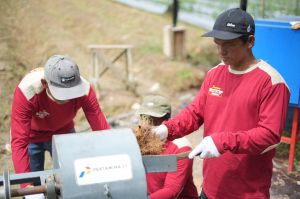
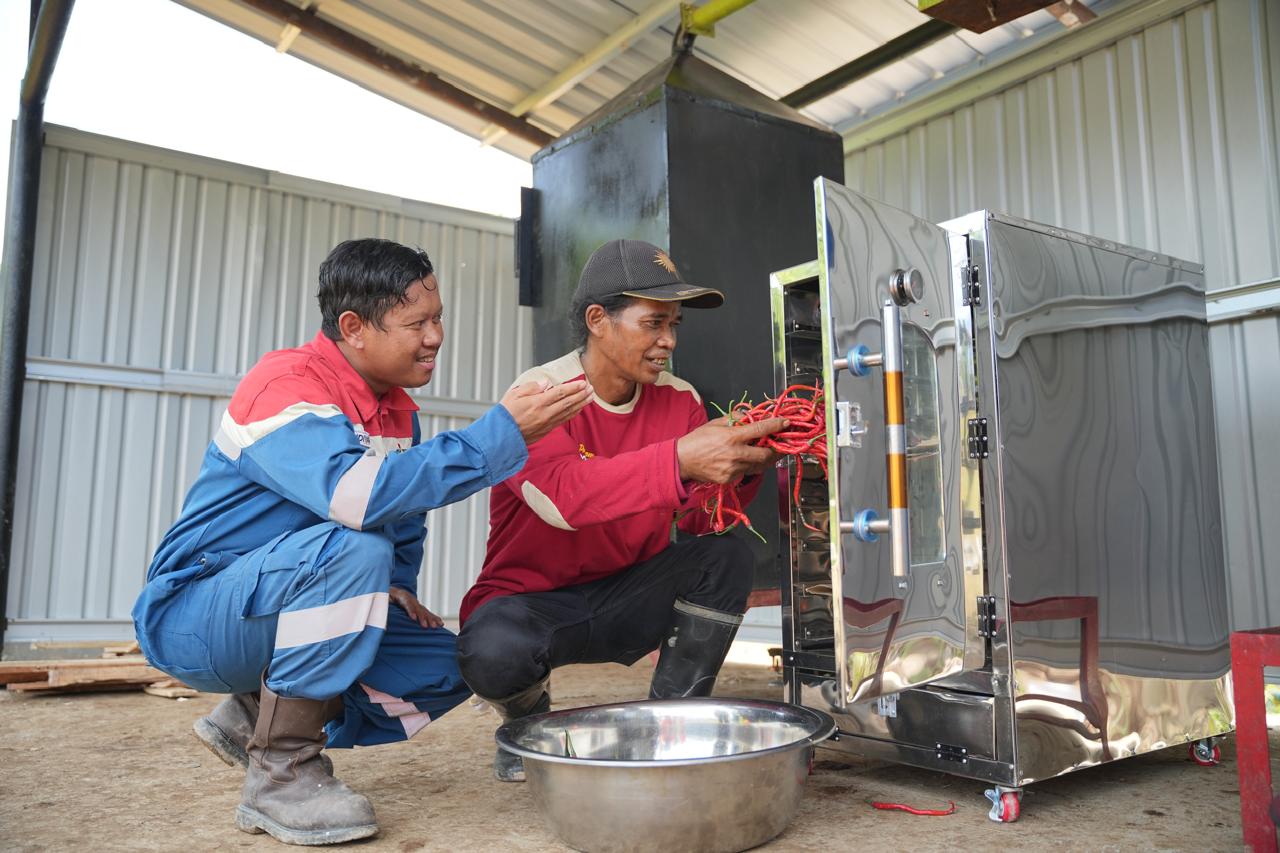
Within this circular scheme, spent mushroom baglogs from oyster mushroom cultivation are used as a mixture for broiler chicken feed. The energy depot, based on a Solar Power Plant/Pembangkit Listrik Tenaga Surya (PLTS), processes palm oil and wood waste into growing media for mushrooms and hydroponics, while also powering hydroponic system pumps. This energy depot also supports semi-organic agriculture by supplying electricity for integrated irrigation systems and the production of plant-based pesticides made from liquid smoke. In turn, the semi-organic agriculture sector receives livestock manure from broiler chicken farming for processing into liquid organic fertilizer, forming a complete and sustainable regenerative agricultural ecosystem.
The program is specifically designed to be inclusive by involving vulnerable groups. A total of 12 underprivileged households are involved in agricultural activities. Four elderly individuals play roles in managing upstream and downstream horticultural agriculture and broiler chicken farming, while 13 socio-economically vulnerable women are actively involved in horticultural agriculture and oyster mushroom cultivation. In addition, 160 households in disaster-prone areas have benefited from a reduced risk of forest and land fires. Overall, the program reaches 30 direct beneficiaries and 620 indirect beneficiaries.
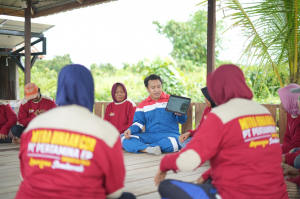
Through PELITA BUWANA, systemic changes have also been created across various aspects. From an intellectual perspective, the groups have obtained business legality through Business Identification Numbers/Nomor Induk Berusaha (NIB), Home Industry Food Production Permits/Pangan Industri Rumah Tangga (PIRT), halal certificates, and PATEN certificates. At the individual level, community members have developed the capacity to process agricultural, livestock, and palm oil waste into organic fertilizers and plant-based pesticides. From a social perspective, the groups have evolved into learning centers through agricultural learning hubs. Culturally, two local traditions, Mapulus and Tasyukuran Tanam Panen, are preserved as part of agricultural activities. From an environmental and infrastructure standpoint, the community can now process approximately 5 tons of waste per year, as well as 2.4 tons of palm oil and wood waste, supported by a solar power plant, liquid smoke equipment, drying equipment, oyster mushroom cultivation houses, and hydroponic installations.
The program is also designed to be sustainable through local leadership regeneration, led by Mr. Choirul Munasikin, also known as Ahmad, a horticultural farmer with more than 20 years of experience who now serves as the Chairman of the ECO-STEP Group. This innovation was born from collaboration between the Company and the community, including the active role of women such as Mardiyah and other members in strengthening the group.
Overall, the achievements reflected in the sustainability compass show a reduction in agricultural input costs of up to IDR 57 million per year, an average increase in member income of IDR 250,000 per person per month, the creation of new employment opportunities in the agricultural and livestock sectors, and the establishment of a knowledge-sharing center for the community of Tanah Datar Village. From an environmental perspective, the program processes 31 tons of organic waste and 120 kilograms of inorganic waste per year. In terms of welfare, 43.3 percent of direct beneficiaries are women, reflecting PEP Sangatta Field’s commitment to delivering social innovations that are inclusive, impactful, and sustainable.
PT Pertamina EP (PEP) Sangatta Field is part of Zona 9 Subholding Upstream Regional 3 Kalimantan, which is led by PT Pertamina Hulu Indonesia. In cooperation with SKK Migas, PEP Sangatta Field runs an innovative Corporate Social Responsibility program across Economy, Education, Health, Environment, Infrastructure, and Disaster Response to support sustainable community empowerment and the achievement of the Sustainable Development Goals (SDGs). PHI is headquartered in Jakarta. More information about PHI-Regional 3 Kalimantan is available at https://phi.pertamina.com.