05
Dec
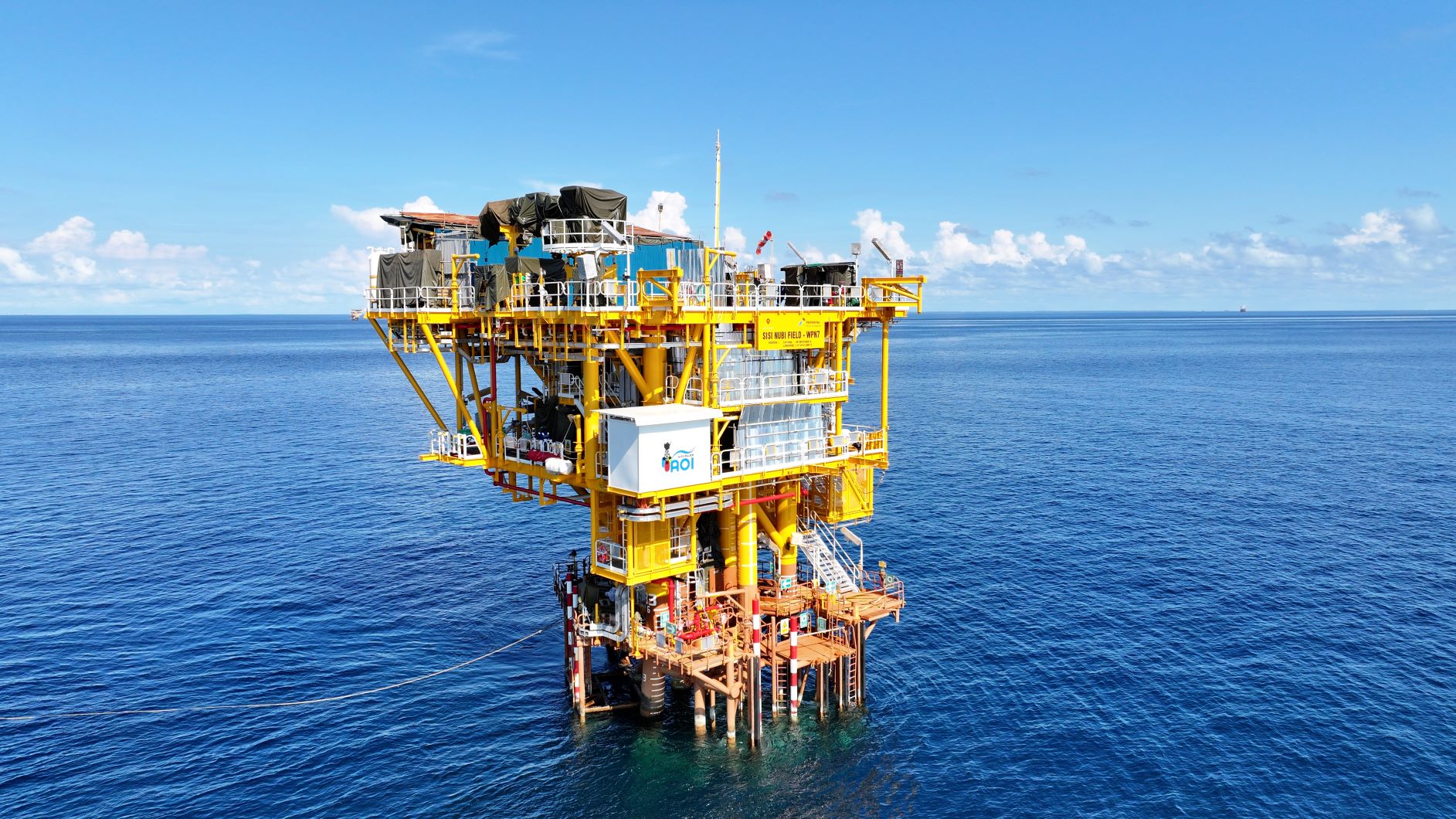
Balikpapan – PT Pertamina Hulu Mahakam (PHM) has officially commenced the onstream of the Sisi Nubi Area of Interest 1-3-5 (Sisi Nubi AOI) Project, a strategic initiative aimed at increasing the Company’s oil and gas production to support national energy availability and security. The project’s success was marked by the first onstream well, SS-401, at the WPS4 Platform on December 4, 2025, at 12:23 WITA with a production rate of 2.4 MMscfd (Adj Choke 24/64”). The well ramped up to a 42/64” choke on December 5, 2025, at 09:10 WITA, reaching 10 MMscfd. As outlined in the project plan, well SS-406 at the same platform will be opened on December 6, 2025, with both wells targeted to reach a combined production of 20 MMscfd by December 8, 2025.
The Sisi Nubi AOI Project includes the construction of six new platforms, three deck extensions on existing facilities, and six subsea pipeline segments totaling 22 kilometers in length at sea depths of roughly 60–80 meters. These developments connect the new platforms to existing facilities, along with 36 development wells to be drilled across the six platforms.
PHM General Manager, Setyo Sapto Edi, stated that the success of the onstream marks PHM’s commitment to supporting the continuity of oil and gas production from the Mahakam Working Area (WK Mahakam), which plays a vital role in meeting Indonesia’s future energy needs. Setyo emphasized that this achievement was made possible through collaboration among PHM workers and partners. “We work closely with all stakeholders, including the Directorate General of Oil and Gas, SKK Migas, and our partner companies, to apply innovation and technology across our upstream operations,” he said.
Setyo reaffirmed that the Company’s commitment to applying innovation and technology aligns with the policies of PT Pertamina Hulu Indonesia (PHI) as the parent company and PT Pertamina Hulu Energi (PHE) as Pertamina’s upstream Subholding. “We believe that deploying innovation and technology is a strategic step to slow natural production decline, increase recovery rates, maintain production levels, and mitigate decline in mature fields across Kalimantan,” he added.
The Sisi Nubi AOI Project is an example of technological innovation across subsurface, surface facilities, drilling operations, and well intervention. Subsurface targeting applied a machine-learning-based, seismic-driven target methodology, which has successfully delivered results beyond expectations in drilling two wells in this project. On the surface technology side, the project features the use of Suction Pile Foundation (SPF), a pioneering approach in Indonesia that enables faster, more efficient, and environmentally friendly subsea structure installation.
The project’s drilling activities also introduced the New Concept–Sacrificial Casing method, an advanced partition system proven to enhance operational reliability and shorten project duration. As a result, well SS-406 achieved the fastest and safest Rate of Penetration (ROP) in PHM’s records. SS-406 also became the first well in Indonesia to perform pressure tests and fluid analysis directly through the drilling assembly. Significant advancements were also recorded in completion work, including the successful installation of single-trip-multi-zones gravel pack sand control and multi-zone packer isolation systems with 9-5/8” and 7” tubulars. These technologies serve to control sand production, isolate reservoir zones for selective production, and prepare for future thru-tubing screen applications to optimize output.
Setyo added that the successful onstream of the development wells at Platform WPS4 marks the beginning of the next production phase, with drilling continuing using two Jack-Up Rigs operating on different platforms. “I am confident that the Sisi Nubi AOI Project will serve as a strong reference for other upstream oil and gas projects. Strong collaboration, integrity, and collective determination will always produce the best outcomes,” he concluded.
During his two-day visit to PHM, PHE President Director Awang Lazuardi underscored PHE’s commitment, as Pertamina’s upstream Subholding, to continued investment in upstream operations based on Environmental, Social, and Governance (ESG) principles. “A large portion of national oil production comes from mature fields that we operate across Indonesia, including in the Mahakam Working Area. The main challenge is maintaining production levels despite natural reservoir decline,” he said.
Awang also highlighted innovation and technology as core pillars of managing mature fields, while noting that human capability remains essential. “The success of upstream investment projects depends heavily on the competence of field personnel. We continue to develop the capabilities of both senior and younger workers, so they remain adaptive, innovative, and responsive to industry challenges,” he explained.
Meanwhile, PHI President Director Sunaryanto stated that PHI and its subsidiaries are committed to applying leading engineering practices from the national and global upstream industry in developing the Company’s operational and production facilities. “The Sisi Nubi AOI Project is not only about offshore infrastructure development, but also about the determination to keep moving forward amid rising operational and business challenges. With a design capacity of 20–25 MMSCFD per platform, this project will enhance PHM’s gas and condensate production, supporting national energy availability and security,” he said.
Several major milestones have been achieved throughout the project. It began with the first cut of steel ceremony at PT Meindo Elang Indah’s yard in Tanjung Pinang, Riau Islands, on January 15, 2024. This was followed by the sail-away of six jackets in November–December 2024, with offshore installation completed from December 2024 to January 2025. Pipeline, riser, and subsea spool installations were carried out between January and February 2025. The sail-away of topsides for platforms WPS4 and WPS5 took place on April 28, 2025, followed by WPN7 and WPN8 on May 6, 2025, and WPN5 and WPN6 on May 16, 2025. Offshore topside installations were completed safely between May and June 2025. These activities were followed by drilling of wells SS-401 and SS-406 at WPS4 from August 13 to November 5, 2025.
Well connection, well intervention, and start-up activities for wells SS-401 and SS-406 continued from November 5 to December 4, 2025. In this phase, PHM applied new Coil Hose technology to efficiently remove completion fluids on minimalist platforms, along with Tractor and Stroker tools to change zones in high-deviation wells. The ramp-up of the first two WPS4 wells continues gradually as data collection and well-parameter observations are underway.
With more than 2,800 workers involved and significant SIMOPS activity, the Sisi Nubi AOI Project is considered highly complex. Even so, all project stages from early 2024 to onstream were completed safely, achieving over 9 million work hours without a Lost Time Injury (LTI). This achievement demonstrates PHM’s strong commitment to consistent HSSE implementation across all upstream oil and gas projects and operations.
PT Pertamina Hulu Mahakam (PHM) is a subsidiary of PT Pertamina Hulu Indonesia (PHI) in Zona 8. It manages upstream oil and gas operations and businesses in accordance with Environmental, Social, and Governance (ESG) principles in the Mahakam Working Area in East Kalimantan. As a Production Sharing Contract Contractor for the Indonesian government, represented by SKK Migas, PHM, along with its subsidiaries and affiliates, PHI also implements innovative Corporate Social Responsibility programs in the areas of Economics, Education, Health, Environment, Infrastructure, and Disaster Response to support sustainable community empowerment and the achievement of the Sustainable Development Goals (SDGs). PHI is headquartered in Jakarta. For further information about PHM and PHI, please visit https://phi.pertamina.com.